 Feedback Bubble
Published 28 October 2026 · By Jonathan Jones
How to Validate SaaS Feature Requests Before Building
A practical way for indie SaaS founders to assess feature requests: preserve the original feedback, look for the need behind it, check context and trade-offs, then decide whether to commit.
A feature request is worth building when you can connect it to a meaningful customer need, understand who else has that need, and justify the cost against your product’s direction. Keep the original messages, group requests that point to the same problem, check the context, and talk to customers before committing work. Request volume is evidence, but it is not a decision.
Start with the problem, not the proposed feature
Customers often suggest a solution because it is the clearest way they can describe what is missing. “Add a CSV export” might mean someone needs to share a report with a colleague, keep a local record, or use the data in another tool. Those needs could call for different solutions, or no new feature at all.
Keep each customer’s wording intact. Then write your own short summary of the problem it may point to. This gives you something to investigate without turning one person’s suggested implementation into the product requirement.
A practical validation process
1. Preserve and group related messages
Save the original requests, then group messages that appear to describe the same underlying need. Do not merge away differences: two customers may ask for the same feature for very different reasons. Keep those distinctions visible when you review the group.
2. Find out who is affected and where
Check which customers have the problem, how often they encounter it, and what they do instead. Note the page or workflow where it occurs. A request from someone blocked during onboarding may deserve a different response from a request for a minor convenience on a rarely used settings page.
Page and device details can help you understand the setting in which someone sent feedback. They cannot explain the customer’s motivation by themselves. Ask a follow-up question when the message leaves an important gap.
3. Look beyond the number of requests
Repeated requests can indicate a shared problem, but the count alone does not tell you its importance. Consider whether the affected customers fit your intended audience, whether the problem is frequent or costly for them, and whether fixing it supports your product’s direction. Also look at the trade-offs: development and maintenance effort, added complexity, and what you would delay to make room for it.
4. Test your understanding before committing
If the decision is unclear, speak with affected customers. Ask what they were trying to do, what happened, how they handle it now, and what the problem costs them in time or effort. Avoid asking only whether they like your proposed feature. Agreement with an idea is not the same as evidence that someone will use it.
You can also test a smaller step, such as doing the task manually for a customer or showing a simple prototype. Choose a test that answers a real uncertainty before investing in a full build.
5. Make a decision and record why
Decide whether to build, investigate further, defer, or decline. Record the need you believe the work addresses, the evidence behind that view, and the main trade-off. If you proceed, describe the intended outcome rather than copying a request as a specification. Revisit the decision if new evidence changes the picture.
Worked example: a request for CSV exports
Hypothetical example: imagine you run a small reporting SaaS and receive three messages asking for CSV export. One customer wants to share a report with a client, another wants to keep a copy for their records, and a third needs to analyse the data in a spreadsheet. The requests sound similar, but they describe different jobs.
Before building, you could check which report pages the messages came from, ask each customer what they do today, and find out whether a download would meet all three needs. You might also check whether the requested format fits the product’s intended use and what work would need to move if you prioritised it.
If the conversations confirm that exporting is a recurring obstacle for the customers you serve, CSV export may be a reasonable planned change. If they reveal distinct needs, you might test one use case first. The three requests inform the decision; they do not dictate that you build a particular solution.
Use an inbox to keep the evidence connected
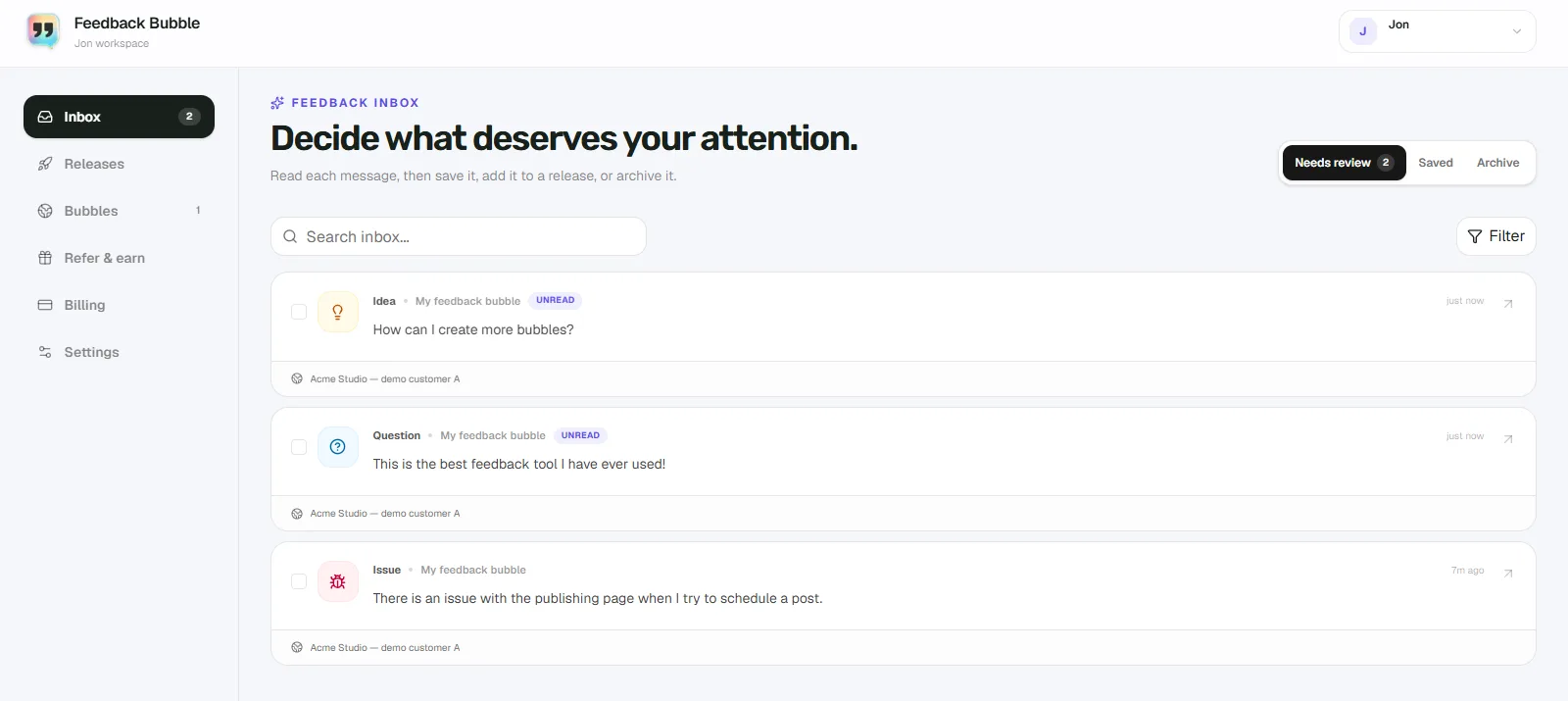
If requests arrive through scattered emails, messages, and forms, it can be hard to find related evidence again. Feedback Bubble brings website feedback into one inbox. You can search messages, filter by feedback type or bubble, review page context, and move useful items to Saved while you investigate. Saved keeps feedback handy without committing it to product work.
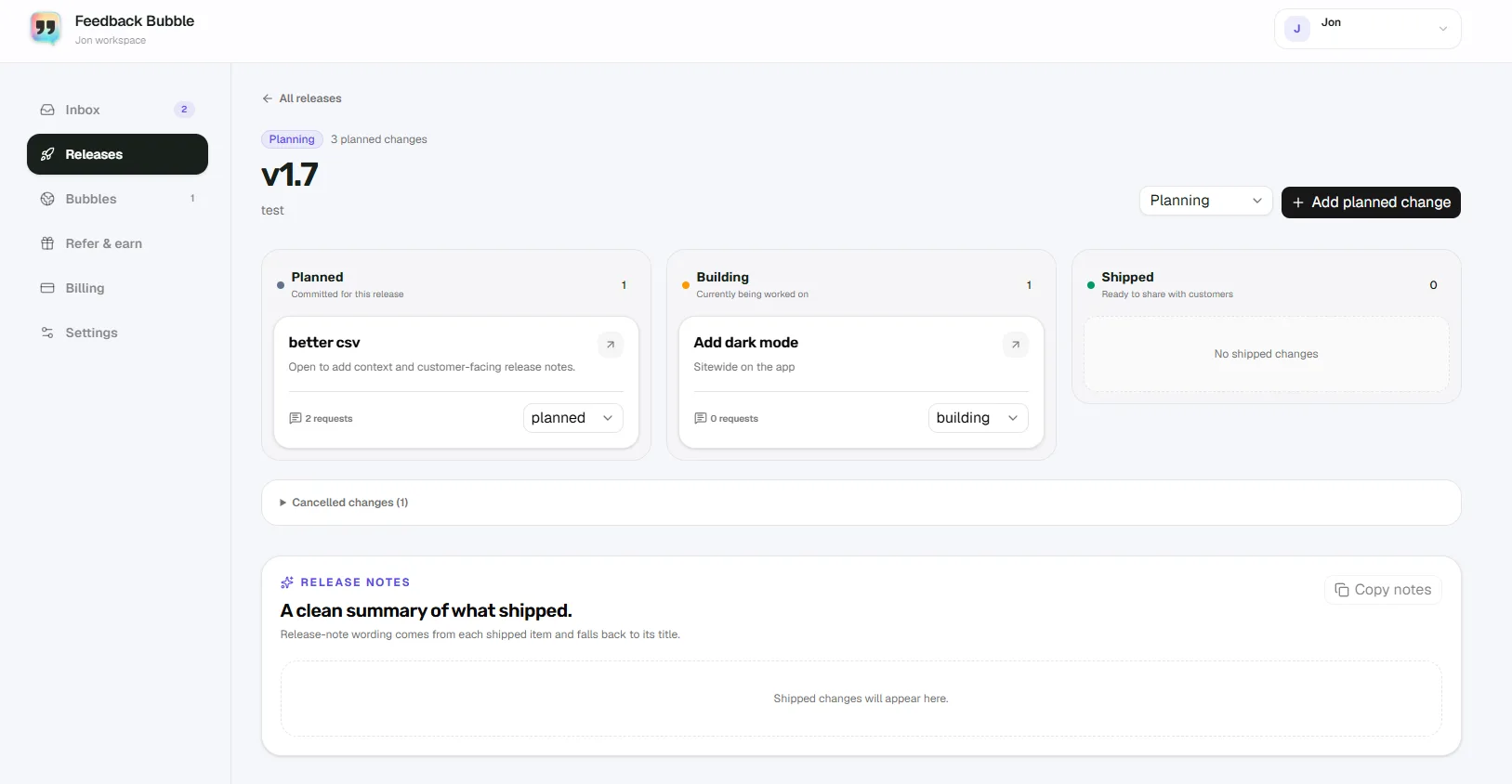
If you decide to act, select related messages and choose Plan change to connect them to one outcome-focused change in a release. Planned changes can move through Planned, Building, and Shipped. The customer messages remain the evidence underneath the work. This organisation helps you review your reasoning, but it does not validate demand or choose priorities for you. For the current workflow, see Feedback Bubble’s features.
Common mistakes when assessing requests
Treating every request as a commitment. Acknowledge the feedback, then investigate before promising a delivery date.
Counting messages without checking who sent them or what they need. A cluster is a useful lead, not a complete measure of demand.
Building the suggested solution before confirming the problem. The customer may need a different outcome from the one their request implies.
Treating silence as proof that nobody has the problem. Some customers do not send feedback, so use other appropriate evidence when the decision warrants it.
When requests conflict, compare the needs and trade-offs rather than trying to satisfy every proposed solution. Read more about handling conflicting feature requests.
Make the next decision easier
For your next feature request, keep the original message, write down the need it may represent, and identify one unanswered question to investigate. That gives you a concrete next step without turning a suggestion into a promise. If you want to keep website feedback and planned changes connected, see how Feedback Bubble works.